Mission Behind Bars & Beyond
Kentucky reentry nonprofit · UX Researcher · 2025–2026
Role
UX Researcher
Org type
Reentry nonprofit
Timeline
2025–2026
Methods
Risk-needs-strengths data, heuristic design, program design
Outcome
215 assessments; high-risk triage heuristic (Laken’s Score); GEN1 policy recommendations; third-party custodian platform; $3.9M+ in grant proposals written
The problem
In 2025, MB3 completed 215 recidivism risk assessments but lacked a fast way to flag the highest-risk cases or track medical continuity across the reentry transition. This engagement built three connected pieces of infrastructure: a disability and risk screening heuristic, a neutral medical-records custodian model, and a cross-population strategic framework used to pursue state policy recognition.
Four connected workstreams
Each addresses a different gap in the reentry transition. Select a workstream to open the project, key metrics, and technical appendix.
1. IORNS and Disability Risk Heuristic215 assessments completed · 31.91% flagged at the highest risk level
Diagnosis
The system: reentry intake is built to document people, not to sort them. Standard intake forms and psychological profiles record history but do not flag who needs intervention first around aggression, hostility or undiagnosed disability. The cost to MB3: 215 recidivism risk assessments in 2025 (200 analyzed in this case study) and no fast way to find the highest-risk people short of a full manual psychological review, so staff time was spread evenly across uneven risk. Among a small cohort who returned to custody within 1.5 years, a shared pattern of hostility, aggression and regulation problems was in the data, but nothing in intake surfaced it in time to act.
Intervention
Built a segmentation model, called Laken's Score, on top of IORNS subscale data. It scores individuals into 1 to 5 risk watch levels and flags anyone scoring 12 or higher for significant intra- and interpersonal risk and psychopathy indicators, and anyone above 14 for a likely untreated disability. Used self-evaluated risk-area rankings to identify which behavioral patterns clustered together most often, then validated the pattern against the small high-risk recidivism cohort to confirm that hostility, aggression, and cognitive regulation problems were the consistent common thread, rather than relying on assumption alone.
Technical appendix
Research and Methodology
Built on the IORNS Subscale Classification Table. Self-evaluated risk areas were ranked by frequency across the Very High Risk and High Risk tiers (aggressive behaviors, negative friends, esteem problems, hostility, relational problems, cognitive and behavioral regulation), and the caseload was characterized by age and gender distribution.
Scoring and Logic
Individuals are segmented into 1 to 5 risk watch levels from IORNS summary scores. A score of 9 or higher indicates very high recidivism risk; 12 or higher indicates significant intra- and interpersonal problems and an elevated psychopathy score; above 14 indicates a likely untreated disability.
Constraints and Assumptions
The validation cohort was five individuals who returned to custody, analyzed with the Nielsen Norman five-user rule for spotting qualitative patterns rather than for statistical significance. All scores are self-evaluated and subject to self-report bias.
Obstacles Encountered
No existing tool translated raw IORNS subscale data into an actionable screening tier. This required building a new composite scoring heuristic from an assessment that wasn't originally designed for rapid triage.
2. Medicaid 1115 Reentry Care Demonstration1,422 releases a month · 44.2% use the ED within 90 days · 10% reduction target
Diagnosis
The system: about 1,422 people leave custody in Louisville every month. 24.7% visit an emergency department within 30 days and 44.2% within 90 days, and about half have a traumatic brain injury or intellectual or developmental disability that calls for medication support and a primary care connection. Release is a treatment cliff: no pathway to a primary care provider, no tracking, limited access to corrections, and housing gaps in the first 60 days and again at 90 to 120. Kentucky's 1115 demonstration covers health-related social needs, but it had no reentry care pathway. The cost to MB3: coordinating care for high-need people after release with no Medicaid pathway to pay for it, while emergency care for this group cost an estimated $1.7M to $3.06M a month in Louisville.
Intervention
Proposed adding comprehensive reentry care management to Kentucky's Medicaid 1115 demonstration, with MB3 as the community operator. Four objectives: disability pre-screening before release, a minimal pathway to establish a primary care provider, medication management, and full care management for the first 90 days. The model runs in four phases (pre-screening, partner flow, systems and data, then condition groupings for TBI, ABI, IDD, substance use and incarceration-related PTSD) and uses the IORNS heuristic for triage. Next steps set: a joint briefing with the Cabinet for Health and Family Services and the Department of Corrections, approval for demonstration inclusion or contracting, and onboarding in January 2026.
Technical appendix
Research and Methodology
Release volume from the Louisville Metro Department of Corrections fact sheet (2022); post-release emergency department use from published research; health and disability prevalence from the National Health Care for the Homeless Council (2024), Coelho, Davis and Key-DeLyria (2024), Dickson, Tillson, Leukefeld et al. (2024) and Dague, McNamara and Westergaard (2025).
Scoring and Logic
Emergency care costs were estimated at $1.7M to $3.06M a month for Louisville releases, about $28.6M a year. Nationally, about 600,000 releases a year imply roughly $2.9B in Medicaid emergency costs; a 10% reduction would be about $293M a year. These are planning estimates, not measured savings.
Constraints and Assumptions
Proposal stage, presented October 2025; inclusion depends on state approval. Kentucky's 1115 waiver is in its demonstration phase. Deliverables include a recidivism assessment of behavioral needs, common medications, condition groupings, validated primary care pathways, best practices, a scoring rubric and a research report.
Obstacles Encountered
Limited access to the Department of Corrections before release, no established partnership pathways with primary care, housing gaps after release, and no shared tracking system, which is the gap Med Vault is designed to fill.
3. Med Vault4 record categories · pre-release onboarding model
Diagnosis
The system: no system (corrections, healthcare, housing or supervision) holds legal, operational or clinical responsibility for a person's medical care as they move from jail to shelter to community. The cost to MB3: staff rebuilding medical histories by hand, plus treatment delays, duplicate tests, medication errors and avoidable emergency visits during the highest-risk weeks after release. By 180 days, 51% of released individuals have stopped filling chronic prescriptions.
Intervention
Designed Med Vault, a neutral third-party medical-records custodian operating under HIPAA-compliant data-sharing and consent agreements, so authorized providers can access a normalized medical record regardless of a client's housing status. The vault captures identification, medication history, assessments, and referrals in one container, and the model encourages onboarding before release so the record already exists before the highest-risk transition period begins, rather than being rebuilt from scratch afterward.
Technical appendix
Research and Methodology
Grounded in the Louisville Metro corrections reentry funnel data: emergency-room use and housing loss at 30, 90, and 180 days after release, alongside national and state literature on medication discontinuity after incarceration.
Scoring and Logic
Not applicable. Med Vault is a records infrastructure and consent model, not a scored assessment.
Constraints and Assumptions
Requires HIPAA-compliant data-sharing and consent agreements across multiple entities (corrections, hospitals, shelters, and community providers), and assumes voluntary enrollment by the individual.
Obstacles Encountered
No existing system claims legal or operational responsibility for continuity of care across the corrections-to-community handoff. Establishing lawful consent and data-sharing agreements across siloed entities was the central design challenge.
4. GEN1 Transition-Age Stabilization Project3 entry points mapped to one shared mechanism
Diagnosis
The system: Kentucky pays for transition-age instability across Medicaid, emergency departments, child welfare, behavioral health, housing, juvenile justice, corrections and workforce programs, yet treats young foster mothers, youth aging out of foster care and reentry adults as separate problems in separate agencies. The cost to MB3: pitching funders and agencies one population at a time, with no frame showing that one mechanism drives costs in many budgets, so no funder could compare where a dollar reaches furthest and no agency could own the fix.
Intervention
Built a comparative strategic model mapping three entry points into the same instability cycle: young foster mothers (two-generation reach), youth aging out of foster care (one generation, the earliest intervention point), and reentry adults (one generation). Each was compared against the downstream systems it touches and its lifetime cost and opportunity value at 30% reach. Used this frame to make the case to the state for recognizing Transition-Age Stabilization as a formal prevention category, and to pursue a cross-cabinet workgroup plus a state-recognized 90 to 180 day demonstration pilot with payer alignment and shared outcome reporting.
Technical appendix
Research and Methodology
A comparative population analysis mapping a shared mechanism (housing instability, untreated behavioral health needs, and emergency department use as default care) across three entry populations, drawing on justice, emergency department, housing, and child welfare data.
Scoring and Logic
Modeled conservatively at 30% program reach. Comparable cost-benefit studies of youth aging out of care assume 50–80% participation. Lifetime and annual value ranges reflect downstream cost avoidance across justice, emergency department, and housing systems.
Source: Fostering Change, “Opportunities in Transition: An Economic Analysis of Investing in Youth Aging out of Foster Care”Constraints and Assumptions
Figures are modeled opportunity value at partial reach, not guaranteed savings. Cross-agency data is currently fragmented across Medicaid, child welfare, juvenile justice, corrections, housing, and workforce systems, which limits precision until a shared dashboard exists.
Obstacles Encountered
No single state agency owns Transition-Age Stabilization as a category. Each entry point sits in a different cabinet with separate eligibility rules and funding streams, which is why the ask became a cross-cabinet workgroup rather than a single-agency request.
Research documents
GEN1: Beyond the Mission
Policy and ROI narrative on interrupting the housing, health, and justice cycle across three populations.
MB3 Medicaid 1115 Reentry Care Demonstration
Proposal to add reentry care management to Kentucky's 1115 demonstration: release-to-ED timeline, cost exposure, four-phase triage model and deliverables.
GEN1 Transition-Age Stabilization Pilot
Pilot model, cost-exposure math, and investment framing for payers and hospitals.
MB3 State-Level Policy Recommendations
Seven state-level changes for Kentucky, from a cross-agency workgroup and a 90-to-180-day demonstration pathway to flexible barrier funds and a shared outcomes dashboard.
Reentry Insights Snapshot
Group-level IORNS findings from 95 adults in reentry and the Laken's Score screening heuristic.
Foundations for Success
16-week emotional regulation and identity program design for women in recovery.
Project visuals

Laken’s Score risk heuristic
MB3 completed 215 risk assessments but had no fast way to spot the highest-risk cases. Laken’s Score condenses assessment subscales into a 1–5 risk-watch level so staff can triage quickly.
Click the image to enlarge
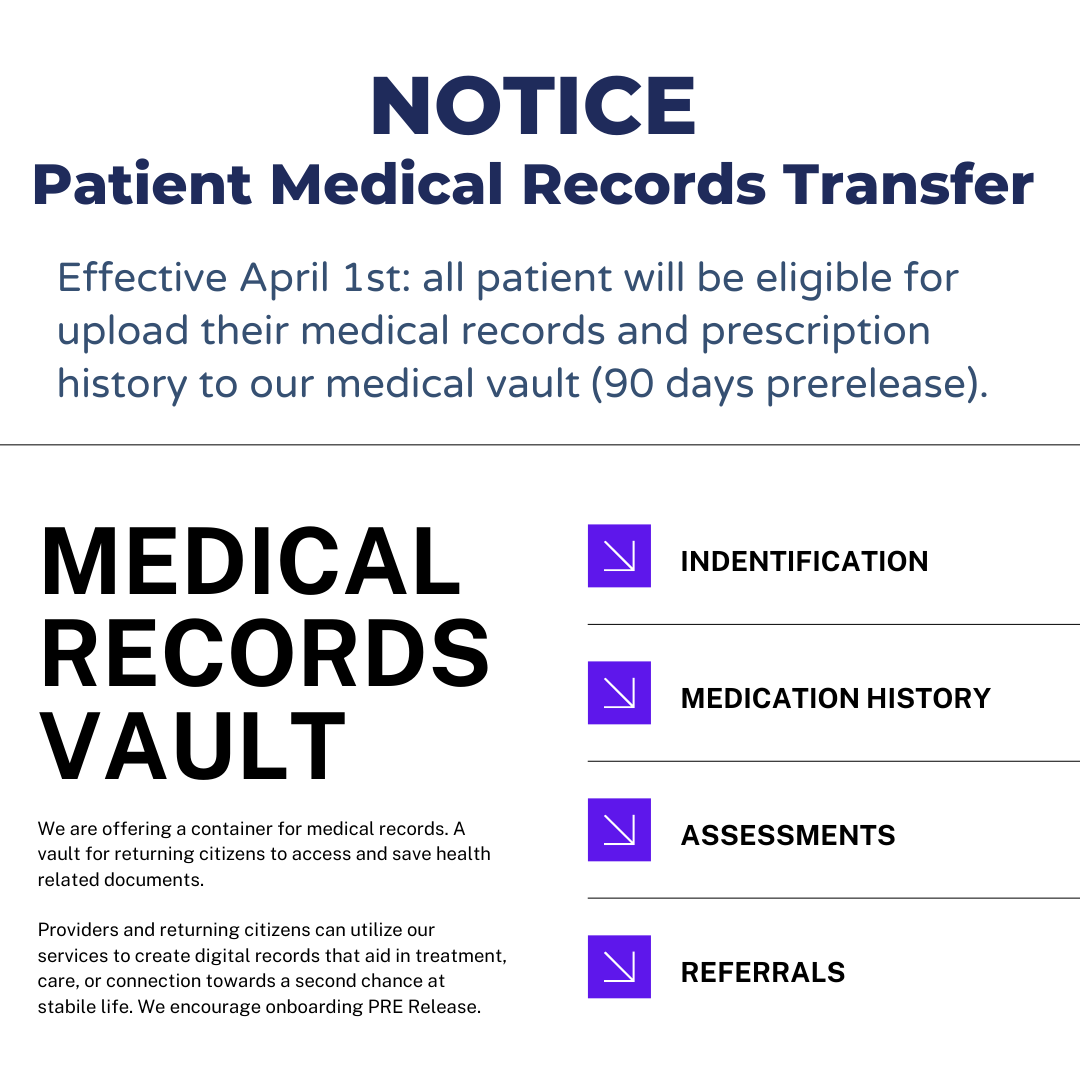
Medical Records Vault
Medical records rarely follow people out of incarceration, which leaves gaps in medication and care. This model proposes a neutral custodian that holds records and keeps care continuous across the transition.
Click the image to enlarge
.png)
GEN1: one mechanism, three entry points
The same stabilization approach serves three populations who arrive through different doors. Framing it as one mechanism turned three separate asks into one, supporting the case for state policy recognition.
Click the image to enlarge